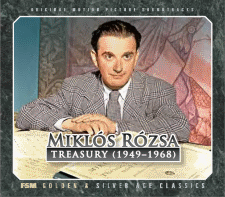
The Light Touch
Richard Brooks directed the European heist caper The Light Touch (1952) and also penned its screenplay (based on a story by Jed Harris). The film marked the second of three collaborations between Brooks (as director) and composer Miklós Rózsa, following Crisis (1950) and preceding Something of Value (1957). Unlike those other two projects, the score for The Light Touch is relatively traditional, offering a delightful “heist” theme and a love theme, both tinged with Mediterranean flavor.
The Light Touch stars Stewart Granger as suave, immoral art thief Sam Conride, who steals a valuable painting and attempts to sell it to various art collectors. Sam double-crosses his crooked partner in crime, art dealer Felix Guignol (George Sanders), by claiming that the painting was destroyed in a fire, and then proposes that they commission copies and pass them off as the original. Pier Angeli (fresh off her success in the 1951 M-G-M release Teresa) stars as Anna Vascari, a lovely young artist whom Sam employs to replicate the painting. As Sam outwits and betrays Felix and negotiates with buyers, he falls in love with Anna—her impenetrable sweetness places him in the tricky position of having to choose between love and money.
While critics praised the film’s performances, particularly those of Granger and Angeli, they took director/screenwriter Brooks to task for the film’s lax pacing. Variety complained, “Entirely too much footage is consumed in unfolding The Light Touch, resulting in a slow offering.” For all of the film’s clever banter, it offers little in the way of action or suspense. On a technical level however, the film remains notable for Robert Surtees’s striking cinematography (the film was shot on location in Italy, Sicily and Tunis) and for Miklós Rózsa’s propulsive score.
Critics singled out Rózsa’s work as one of the film’s chief assets, with Variety praising his “intriguing stringed music.” The mischievous main theme speaks both to Sam’s nature and to the film’s European locales, with a bouncing chromatic melody creating a light, manic urgency under the film’s numerous conversations and expositions. It manages to encapsulate the more threatening aspects of the story as well as the detached humor of the picture. In stark contrast to the Sam-related heist music is the tender material for Anna: the aching love theme, “Viso Perduto,” is a musical representation of Anna’s purity, subtly introduced but eventually overwhelming the principal theme, since love does indeed triumph in the end.
The January–February 1952 issue of Film Music Notes offered the following insight into Rózsa’s score, crediting M-G-M music director Johnny Green with suggesting the general musical approach:
The musical score of The Light Touch is a good example of the editorial creativeness of Johnny Green in his supervision of things musical at Metro-Goldwyn-Mayer. Discarding the typical approach to a whodunit score for this picture, he suggested the desirability of using two themes of an Italian folk nature, one to indicate the romance between the principal characters, and the other the “light touch” proclivities of the painting thief. The entire score was to be played by a tiny, typical Italian-sounding orchestra. Dr. Miklós Rózsa did a wonderful job of composing in the Italian folk idiom and of judiciously using the two themes in a simple, straightforward manner throughout the picture. Dr. Rózsa’s orchestra consisted of four mandolins, two guitars, accordion, six strings, two woodwinds, piano and percussion.
During the scenes taking place in the so-called Souk (Native Quarter) section of Tunis, music composed by Charles Wolcott to simulate indigenous music was used. Four themes were written for an orchestra consisting of mandolin, mandola, accordion, guitar, percussion, two woodwinds, two violins, two celli and bass. Also a simulated Oriental female voice can be heard in some of these tracks. The recordings of these themes were used sometimes singly, sometimes simultaneously to create the impression of the mélange of musical sound typical of this Native Quarter of Tunis where one’s ears are assailed by scratchy phonograph records being played on all sides at one time.
Green expressed his appreciation—and that of studio chief Dore Schary—to the composer in a memo dated August 28, 1951:
Dear Miki:
Mr. Schary has asked me especially to make a point of congratulating you on your brilliant job on The Light Touch score. You already know how delighted I was with the results but sometimes it is nice to have a somewhat more formal recognition.
I want to take this opportunity to thank you officially for you cooperation in doing this score at a time when it necessitated the postponement of your long-awaited vacation. You are a joy and a comfort to our Department and the Studio is proud of you.
Thanks again and repeated congratulations.
JOHNNY GREEN
This premiere release of Rózsa’s complete score for The Light Touch is mastered from ¼″ monaural tape (presented with a subtle stereo reverb to enhance the ambiance) of what were originally 35mm three-track stereo masters. Also heard in the film, but not included here due to space limitations, are a handful of “ethnic” source cues (“Souk #1” through #4) composed and conducted by Charles Wolcott; these were recorded on July 6, 1951, roughly a month before Rózsa recorded his cues (on August 11 and 13).
- 21. Main Title
- Rózsa’s introduces his main theme, a spirited tarantella, over the opening credits as art thief Sam Conride (Stewart Granger) cases a Sicilian museum; he sets his sights on “The Saviour,” a prized religious painting—on loan from a local church—said to have transformative powers. A jaunty B theme follows Sam outside, where he spots a potentially troublesome traffic cop before the cue concludes with a reprisal of the primary theme.
- 22. The Robbery
- Sam returns to the museum and—with the help of an inside man—the heist is on. Rózsa builds comedic tension with his main theme, playing through Sam’s flirtation with a pretty, young artist (she has drawn a sketch of Sam and he playfully destroys the evidence by obscuring the image with a beard and glasses) as well as a false alarm when a security guard berates a museum visitor for smoking. Sam escapes unnoticed with “The Saviour” discreetly concealed it inside a tapestry; in his getaway vehicle, he hides the painting in the bottom of a typewriter case as the theme’s relentless bass line quietly dissipates.
- 23. The Typewriter
- Rózsa voices his main theme on clarinet as Sam boards a small boat to head for Carthage. The typewriter case nearly falls overboard with the painting inside, but Sam catches it in the nick of time—with the crunchy split thirds of the B theme playfully underlining the near-catastrophe.
- 24. Tunis
- A title card announces that the locale is now “Tunis, North Africa,” and the score follows suit with exotic percussion-dominated music, featuring a repeated-note woodwind melody over a mechanical drone. Approximately 0:08 of this cue is used in the film.
- Arabesque
- Sam arrives at a decadent art show, where this source cue is performed on screen by a small group of musicians. A slinky piece written in the harmonic minor mode, it plays under the introduction of struggling painter Anna (Pier Angeli) and continues through Sam’s rendezvous with his charmingly wicked associate, Felix (George Sanders). The cue comes to a tense conclusion when Sam lies to Felix and a potential buyer, Mr. Aramescu (Kurt Kasznar), telling them that the prized painting was destroyed in a fire.
- 25. Orientale, Part 1
- Sam and Felix scan the party for a candidate to replicate the supposedly destroyed painting. A seductive bolero-like source cue accompanies shots of various shady but unsuitable artists.
- Orientale, Part 2
- The swindlers spot Anna and determine that she may be fit for the task. The bolero continues, albeit with softer woodwind colors, when Felix introduces Sam to Anna. She greets Sam’s initial sarcastic advances with hostility, but agrees to let him walk her home.
- 26. Viso Perduto
- Rózsa introduces his love theme for The Light Touch as Italian source music heard emanating from a phonograph outside Anna’s house, where Sam explains that he can help Anna’s career. This yearning melody, arranged for tenor, mandolin, accordion and strings, has a contour that suggests the main theme, as if to reflect the eventual impact of Anna’s decency on Sam. Approximately 1:00 of this cue is heard in the film. The lyrics are by Hugh Gray; the singer is Gil Russell.
- 27. The Portrait
- Sam views a replica that Anna has painted and is convinced of her abilities. Rózsa reprises the main theme, which serves as a reminder of Sam’s crooked motivations; when he posits to Anna the idea of passing off a copy as an original, she is offended. The first non-source rendition of the love theme accompanies Sam’s response to Anna’s declaration of her honest principles.
- 28. Anna and Sam, Part 1
- This gentle reprise of the love theme plays as Anna and Sam have lunch at a café.
- Anna and Sam, Part 2
- A grander statement of the love theme serenades Anna and Sam on a wagon ride and subsequent romantic walk along the beach. One of Felix’s henchmen, Anton (Norman Lloyd), spies on the couple from afar, although the score does not acknowledge his sinister presence.
- 29. False Pretense
- A spry clarinet takes up the main theme and carries it through a series of ornamental developments before giving way to a gentle statement of the love theme. This cue does not appear in the film; it is unclear what action Rózsa meant it to underscore and it may have accompanied deleted footage.
- 30. Happy Sam
- Sam showers Anna with flowers and clothing, as well as $400 for her copy of “The Saviour.” Anna is unaware that Sam intends to sell her duplicate as the original and the bittersweet version of the love theme that appears here (the first 0:15 of which is not used in the film) is indicative of her naiveté, but perhaps also of Sam’s emerging feelings for her. The main theme accompanies Sam back to his hotel, where he finds Felix, Anton and the imposing thug Charles (Mike Mazurki) ransacking his room in search of the original painting.
- 31. Three Visitors
- A sneaky arrangement of the main theme underscores Sam’s attempt to convince Felix of his intentions to sell a replica painting to R.F. Hawkley (Larry Keating). Felix encourages Sam to marry Anna so that she will not be able to testify against him, should their plot backfire. The theme runs its course when Felix orders his men to track down Hawkley’s associate, MacWade (Rhys Williams), in search of the original painting.
- The Letter
- Anna learns that Sam has been using her and confronts him. He manipulates her by pretending to read her a letter in which he has regretfully confessed his scheme and admitted his love for her. Rózsa’s cue enters with a reprisal of the love theme when Anna breaks down and accepts Sam’s apology—and his marriage proposal.
- 32. Trouble
- Sam phones Macwade and informs him that an ongoing police investigation has made it impossible for him to sell “The Saviour” to Hawkley. The main theme plays through this conversation and takes on a heightened, fateful quality when the phone call is interrupted by Charles, who arrives at Macwade’s hotel room with violent intentions. Sam hears the struggle on the other end and places a call to learn that Aramescu is now in Sicily; the dry, slicing accompaniment of the main theme closes out the scene.
- Unpleasant Discovery
- Newlyweds Anna and Sam travel to Italy on a passenger ship, but en route, Anna discovers the original “Saviour” hidden in Sam’s typewriter case. A brisk, tightly wound version of the main theme intensifies her moment of realization and reaches a climax as Sam enters their stateroom and finds her with the painting.
- 33. New Start
- A wounded, minor-mode development of the love theme plays to the strain between the couple. Sam encourages Anna to leave him before he hurts her again, but she refuses to stop loving him, as confirmed by the return of the love theme in its purest form.
- Accordion
- The locale shifts to Taormina, Sicily: this leisurely accordion source cue (the final part of which was dialed out of the finished film) plays under Sam’s arrival at Hotel Tramonto, where he hopes to find Aramescu.
- 34. The Greek Theater
- Anna visits Greek ruins to add the finishing touches to her replica of “The Saviour.” Rózsa’s impassioned love theme adds historical weight to the scenery while underlining Anna’s noble intentions when she ages the painting by baking it in an oven, in hopes of passing it off as the original.
- Exchange
- Back at Hotel Tramonto, Sam checks for Aramescu in the lobby once again, this time with the applied pressure of a freshly reharmonized statement of the main theme. Meanwhile, Anna returns to their hotel room and switches the real painting with her freshly completed version. Low-register clarinet takes up the main theme, dressed with flute flourishes; for the first time the score’s principal material is applied to Anna, appropriate since she is now running a scam of her own.
- 35. Brutality
- Anna revisits the Greek ruins to contemplate her predicament. A threatening development of the main theme underscores the presence of Charles, who turns up to manhandle her in hopes of learning where the painting is hidden. Rózsa continues to develop this material as the action cuts back to Sam’s hotel, where Felix and Anton have just arrived, hot on the heels of Aramescu. The cue builds to a dramatic climax as the two thieves open the door to Sam’s room to find—no one.
- 36. Alone
- Anna explains to a confrontational Sam that she switched the paintings to keep him from being arrested by a detective, Lt. Massiro (Joseph Calleia); she finally has enough of Sam’s betrayals and storms out. The somber variation on the love theme from “New Start” (track 33) haunts Sam while he despondently takes a phone call and spots Felix outside his hotel window.
- 37. Remorse
- Rózsa reprises the downtrodden love theme for a closeup of a telegram from Aramescu, who still intends to purchase the original painting from Sam. An abbreviated 0:15 version of this cue is heard in the film, lasting long enough to express Sam’s continued inner turmoil.
- 38. Transformation
- Sam has served up Felix to Massiro, along with Anna’s fraudulent painting, but an important choice is yet before him. Rózsa’s love theme, restored to its original major-mode incarnation, underscores Sam’s final meeting with Aramescu. Sam decides he cannot sell the original painting: Anna’s purity, and perhaps the power of religion, has forever changed him.
- 39. Finale
- Anna sees that Sam has returned the original painting to its rightful place and runs to catch up with him outside the church. The love theme was meant to underscore their reunion and continue through Felix’s declaration that he has lost Sam, but in the film the scene plays in silence. The final 0:20 of Rózsa’s cue, featuring the grandiose culmination of the love theme, is dialed into the film for Sam and Anna walking off together under the end title cards.
- 40. Viso Perduto (short version)
- Closing this premiere presentation of the score is an alternate, shorter version of the “Viso Perduto” vocal heard in track 26. —